A structured, multi-scale neuronal code for economic decisions
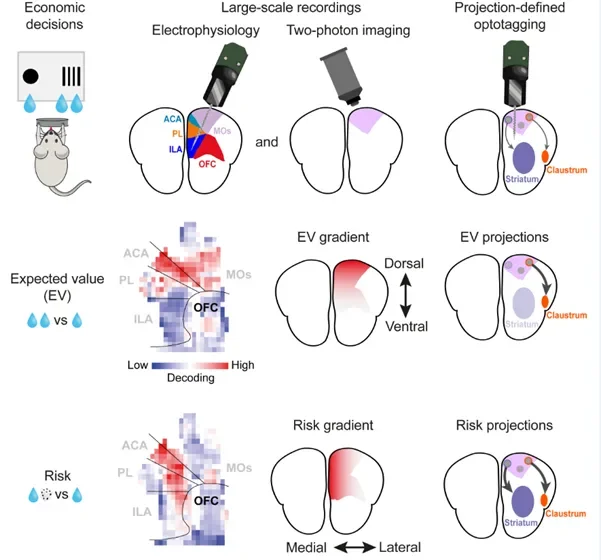
Our brains constantly weigh risk against reward — but where and how does this calculation happen? A new study from the Lak Lab, published in Neuron, reveals that the frontal cortex encodes expected value and economic risk in distinct spatial gradients, with value signals strongest in dorsal regions and risk signals strongest medially. Crucially, what individual neurons encode also depends on where they send their outputs, with projections to the striatum and claustrum carrying different economic information.

Temporal regularities shape perceptual decisions and striatal dopamine signals
Our brains make accurate visual decisions despite receiving noisy, ambiguous input — but how? Part of the answer lies in exploiting patterns in time. When something has been true recently, it is likely to stay true, and the brain can use that regularity to guide perception. A green traffic light probably won't turn red in an instant; a yellow one might. Adapting to these different patterns requires flexible learning. In a new study published in Nature Communications, Dr Matthias Fritsche and colleagues showed that mice adapt their visual decisions to temporal regularities, and that this adaptation is driven by surprisingly simple reinforcement learning algorithms. Dopamine — the brain's key reward signal — tracked these adaptations in real time, suggesting a shared neural mechanism for learning from the environment and shaping perception.
A Bayesian and efficient observer model explains concurrent attractive and repulsive history biases in visual perception
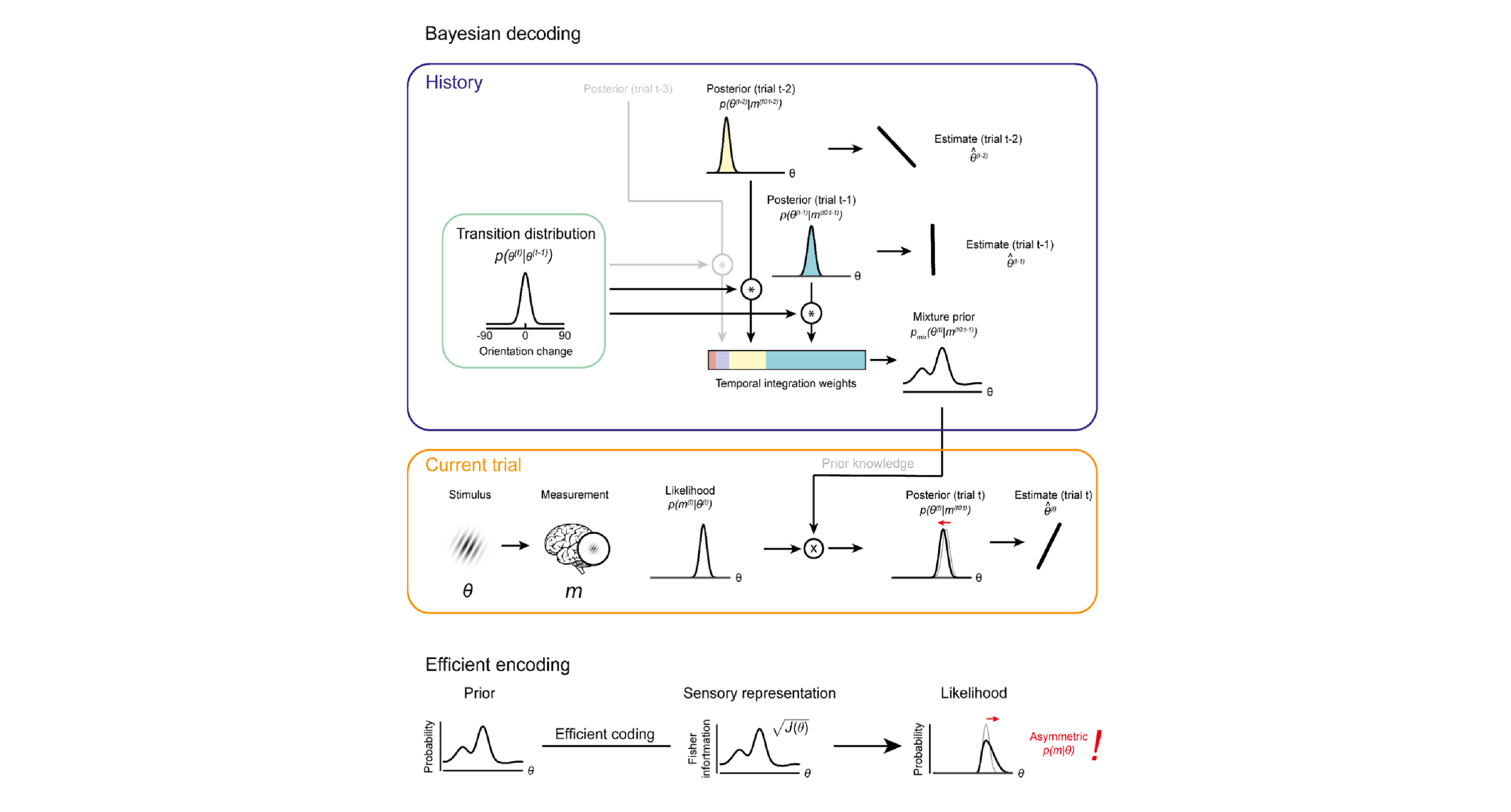
Human perceptual decisions can be repelled away from (repulsive adaptation) or attracted towards recent visual experience (attractive serial dependence). It is currently unclear whether and how these repulsive and attractive biases interact during visual processing and what computational principles underlie these history dependencies. Here we disentangle repulsive and attractive biases by exploring their respective timescales. We find that perceptual decisions are concurrently attracted towards the short-term perceptual history and repelled from stimuli experienced up to minutes into the past. The temporal pattern of short-term attraction and long-term repulsion cannot be captured by an ideal Bayesian observer model alone. Instead, it is well captured by an ideal observer model with efficient encoding and Bayesian decoding of visual information in a slowly changing environment. Concurrent attractive and repulsive history biases in perceptual decisions may thus be the consequence of the need for visual processing to simultaneously satisfy constraints of efficiency and stability.

Impaired Motor Recycling during Action Selection in Parkinson’s Disease
The human motor system recycles motor parameters of previous actions when programming new actions, promoting efficient motor behavior. Here, we investigated the contribution of the basal ganglia to this transfer of motor parameters over subsequent actions. We assessed motor recycling by analyzing kinematic movement parameters during sequential hand movements that involved either a switch or no switch between hands. Compared with matched controls, Parkinson’s patients were impaired in transferring previously used motor parameters to new actions, but only when switching actions between hands. This suggest that the basal ganglia are important for motor recycling, and that the impaired ability of Parkinson’s patients to perform this computation may result in motor slowing.

The role of feature-based attention in visual serial dependence
In this paper we show that feature-based attention strongly modulates visual serial dependence, and differentially affects attractive biases between similar stimuli versus repulsive biases between dissimilar stimuli.